Emerge Career
April 2026 - Present
Founding Product Engineer
Office Manager & Merch Designer
“If you don't wanna be broke, go get it done.”
Raheine, Bronx. Earned his commercial driver's license in August 2026 on the first attempt. He now drives for $83K a year.
Directed the shoot and cut the video. It runs as the onboarding video for every new student on the platform.
Emerge Career trains formerly incarcerated and low-income people, helping to break cycles of poverty and incarceration by building pathways to high-paying careers in the trades. Students get trades certification, hands-on training, and employment placement. Government partners fund it on outcomes and earn a 55x return: graduates stay out of prison and move off public benefits into a tax-paying income band.
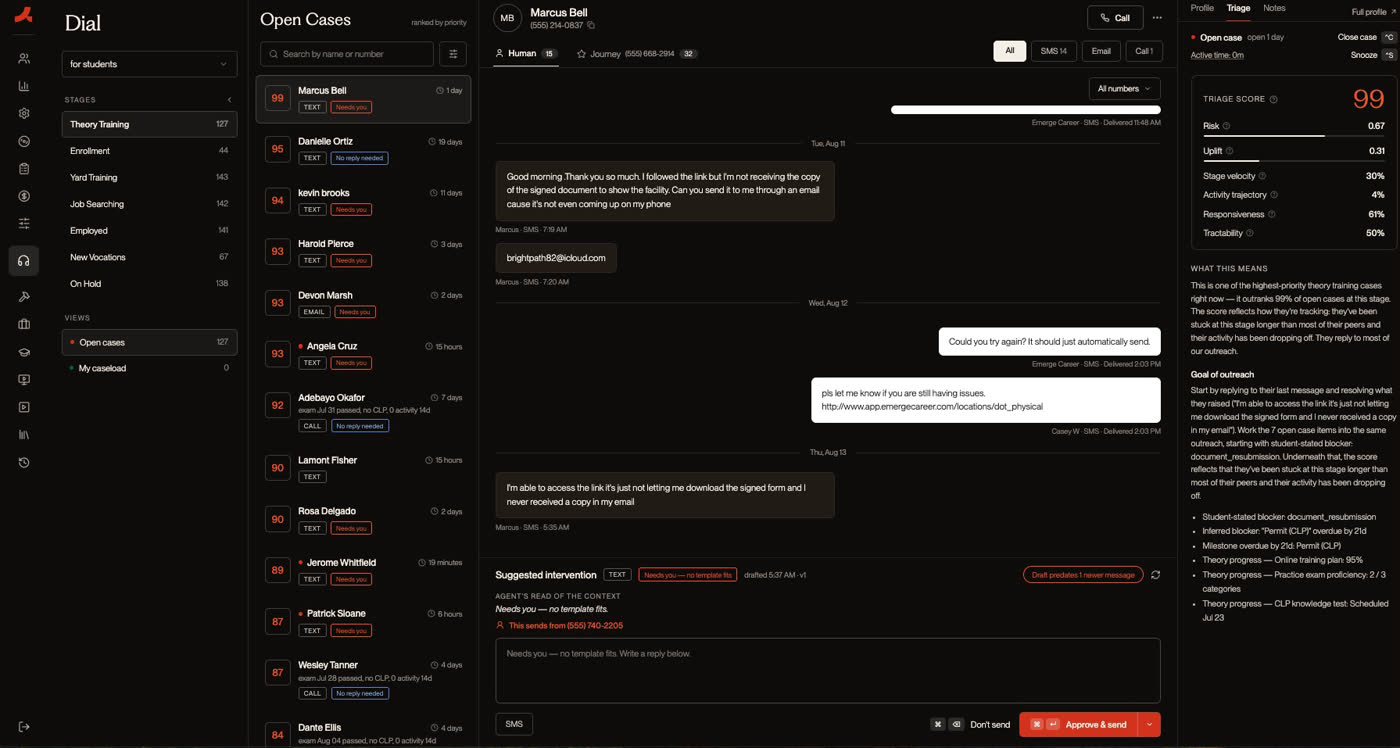
AI Case Management:
Student support was reactive: a coach helped whoever wrote in that day, and students who went quiet dropped out unnoticed. Built the case management system that replaced the vendor tool and now runs all student support.
It scores every student hourly on risk of dropping out, opens a case the moment someone stalls, drafts the outreach from the student's record, and routes the call. Coaches approve messages instead of writing them. Shipped the companion iOS app so coaches take student calls from their phone.
The drafting system learns from its own edits. Every coach correction is logged, and once a week the system proposes new voice examples, facts, and rules for the team to vote on.
Hourly
Every student re-scored for dropout risk
5 min
From a student action to a draft in the coach's queue
Weekly
The system proposes its own improvements from coach edits
Human
Approval on every send
Growth Experimentation:
Ran a weekly experimentation program on activation, engagement, and conversion across the student funnel, from first login to permit exam.
Results since August
+55pp
Permit exam booking rate
2x
Course completion rate
+10pp
First-lesson completion rate
+3pp
Weekly engagement
Meeting Intelligence:
Built the assistant that joins every recorded student meeting, writes the notes into the student's record, and makes the transcript searchable for coaches.
It also cuts each recording into clips of key moments and files them by theme. Marketing now pulls student stories from a library instead of scheduling shoots.
988
Meetings indexed and searchable
95%
Of recorded interviews clipped automatically
AI Data Assistant:
Built a permissioned natural-language interface to the company database inside Slack. Anyone on the team asks a question and gets the answer with the records behind it. Access follows each person's role.
Backtests
100%
Accuracy
99%
Precision
Automated Exam Booking:
Students who set a permit exam date within three weeks of starting were 12x more likely to earn the permit. Built the bot that books the DMV appointment for them.
Also shipped:
Referral program. A new acquisition channel. Students earn a bonus when a friend signs up and again when the friend earns a permit.
Partner dashboard. Referral partners track their own students through the program without emailing a coach.
Natural-language search. Staff find students by describing them instead of filtering tables.
Passwordless login. Students log in with a code, including inside correctional facilities with no email access.
New program lines. Expanded the platform from one trade to three (commercial driving, diesel technician, HVAC).
Financial aid. Exam and medical fees reimbursed on auto-approval, with upfront grants for students who cannot front the cost.
Also In The Job Description:
Office Manager
Led a key people function by taking responsibility for vendor management and procurement of snacks biweekly.
Merch Designer
Designed the company merch that the team actually wears.