Playbook · Last updated October 11, 2026
Taking a Product from 0-1 Using Social Media
Summary
Social media presence is an essential growth lever for early stage consumer-focused businesses. An effective social media presence can drive acquisition, engagement, and growth at little to no cost, and is a key way to learn about your users and improve your product in the early stages of the product life cycle. With that being said, social media in and of itself is not valuable to your business. Its value comes from the problems that it can solve. This guide will focus on how to use social media to solve business problems, focusing on these three categories:
- I want to showcase my offering to potential customers, but I can't because I am not able to communicate with them at a reasonable cost. (IE. I'm having a hard time getting views or engagement on my content.)
- I want customers who are familiar with my brand to purchase my offering, but I can't because the value proposition is unclear to them or they are not motivated enough to make a purchase. (IE. People are engaging with my content as entertainment, not with purchasing intent.)
- I want customers who have purchased from me to purchase again and spread the word about my product, but my product hasn't yet achieved a profitable lifetime customer value or viral growth.
Taking a problem-first framing to social media will help you avoid the common failure mode of overspending (in time or money) on this area of your business.
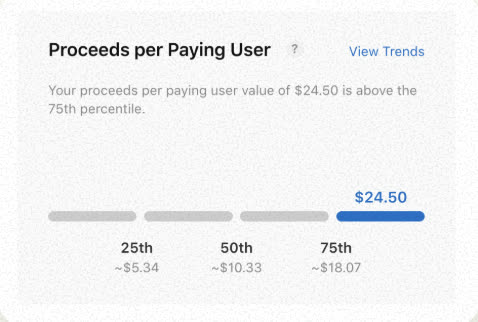
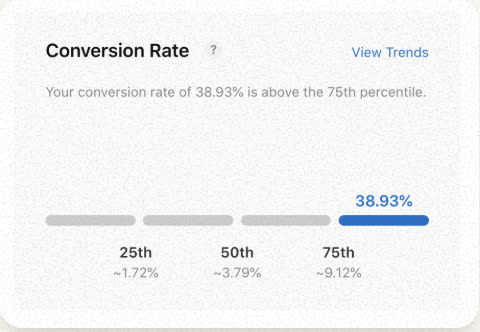
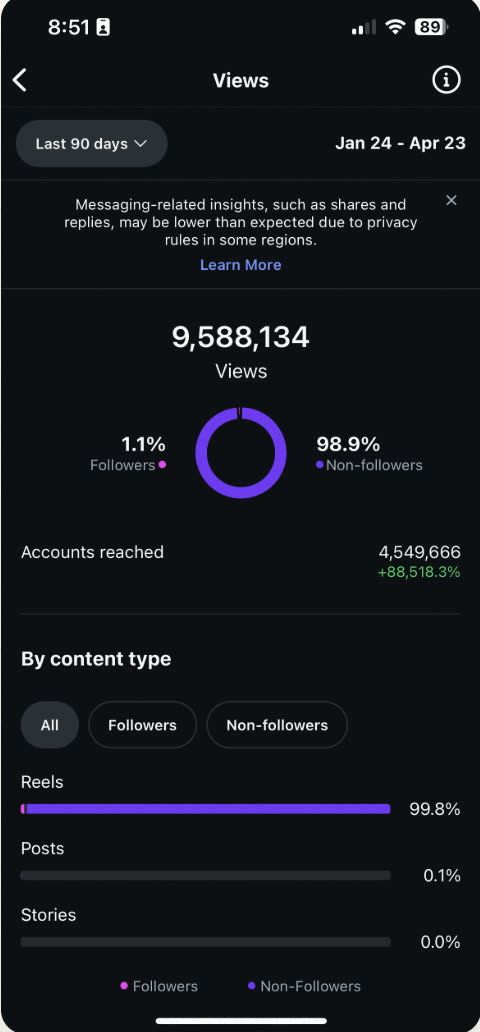
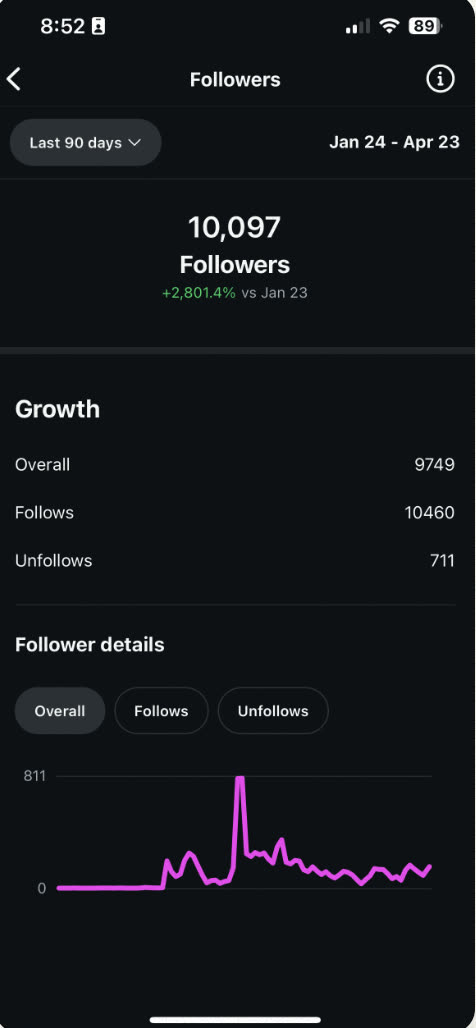
In this guide I'll demonstrate tactics that have solved the above problems in businesses that I've grown to >10M monthly views and >$10K in monthly revenue. Let's jump in!
Problem 1: Getting Views
Getting views on your content is important because it helps solve the following problem:
Getting views on your content is about building a sense of familiarity and trust between your potential customers and your brand. As such, the first thing you need to do to grow on social media is to decide on a face for your brand.
Tactic 1.1. The face of your brand
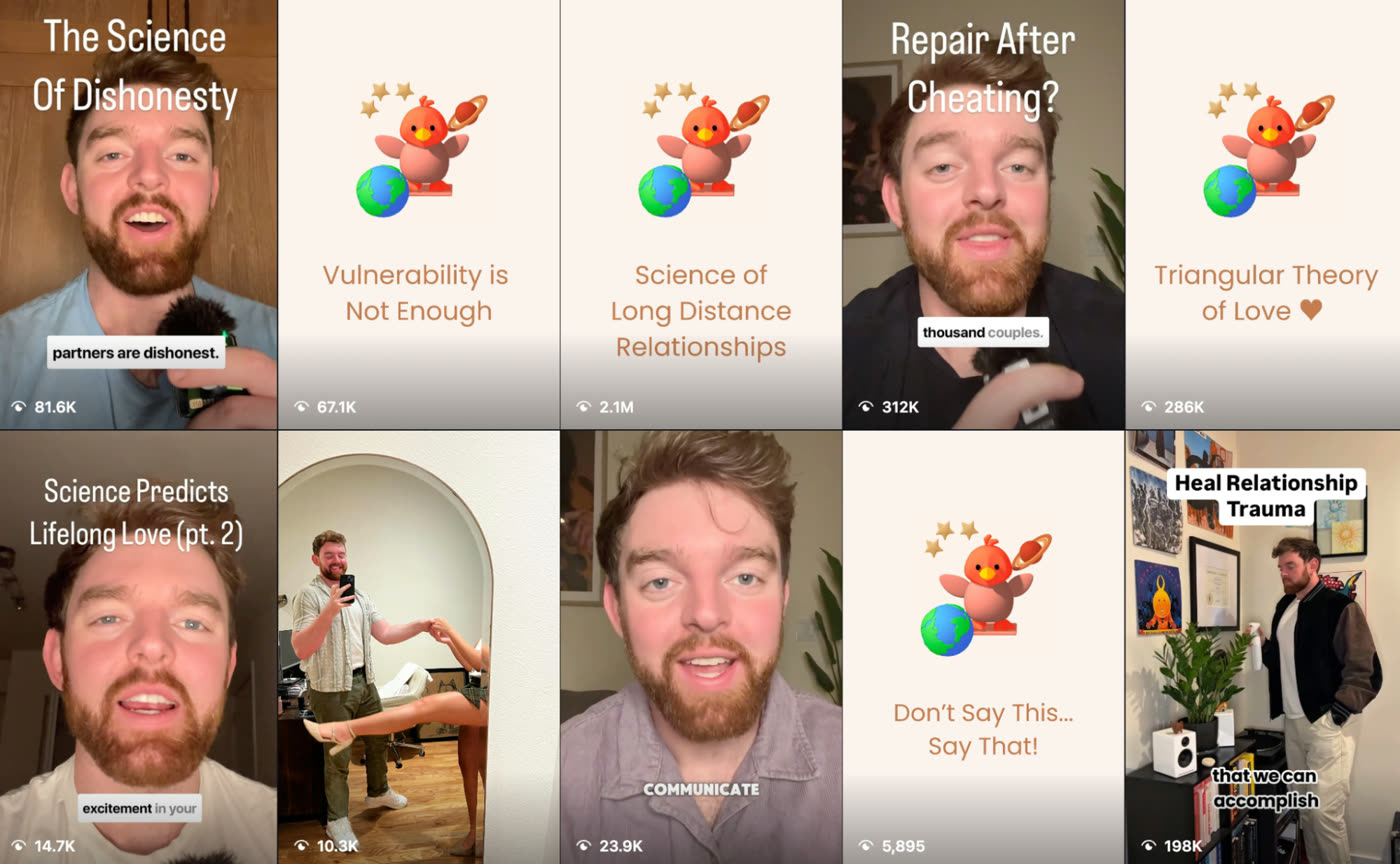
The goal of getting views on your videos is to build familiarity and trust between your brand and your audience. The easiest way to do this is by having the same person (the face of your brand) be present in the vast majority of your content. This person will need to speak confidently and charismatically about content related to your brand. Because familiarity with and interest in the brand's category is so important to building audience confidence, there's a good chance that the face of your brand should be you.
Learning what speaks to your audience is an invaluable thing for your business, so even if you perceive yourself as more of a product or back of house person, this exposure to your potential customers will vastly improve the chance that you'll build a product that your potential users are actually interested in engaging with. If you decide not to be the face of your brand, it's important to pick someone that has high buy-in to your business, potentially a cofounder, because this person will ultimately be responsible for building a base of trust and goodwill between your business and its customers. This is not a responsibility to outsource lightly.
Once you've decided on a face for your brand, this person should be visible in nearly every piece of content you post. The more your audience sees this face delivering useful or entertaining content, the faster they will learn to trust your brand's expertise in its category.
Tactic 1.2. Deciding what to post
Two extremely important factors in your business's success will be:
- The clarity of the definition of the problem you solve
- How effectively your product solves that precisely defined problem
Your content should help you define your problem more clearly. To decide what to post, you should start with hypotheses about what types of problems your potential customers might experience, and then make content that could help them solve those problems.
For example, if your business is in the wellness space and focuses on self-regulation strategies, you might want to post content that offers strategies for self-regulation in chaotic environments. If you're able to present this information in an entertaining, trustworthy, and informative way and it is truly a pain point that your users face, then the content will perform well. If it turns out that it's not such a problem for your users, you'll learn this quickly and have more time to test alternative problem definitions.
If you're starting from scratch, your content should be testing hypotheses about user pain points. Once your content starts performing, users will tell you about their pain points and the type of content they'd like to see by commenting with requests.
Tactic 1.3. Structuring your posts
Good artists borrow, great artists steal. The best way to accelerate your content's path to virality is to find similar content that's already performing well and copy the most important parts, beat for beat.
There are a few steps you can take to find an effective “comparison account” to copy.
- Find a creator who has already developed a following in your category.
- If your category is wellness, this might be Emily MacDonald, for example.
- Try to find someone who isn't relying on some competitive advantage that you don't have. If you're building in the wellness space, for example, you shouldn't use Andrew Huberman as your comp account unless you also have a Stanford PhD, because his content relies on that demonstration of expertise.
- Once you've identified your comp account, scroll through their profile to find content that is outperforming their baseline.
- For example, if their average view count is 10K, look for a reel that has 100K views.
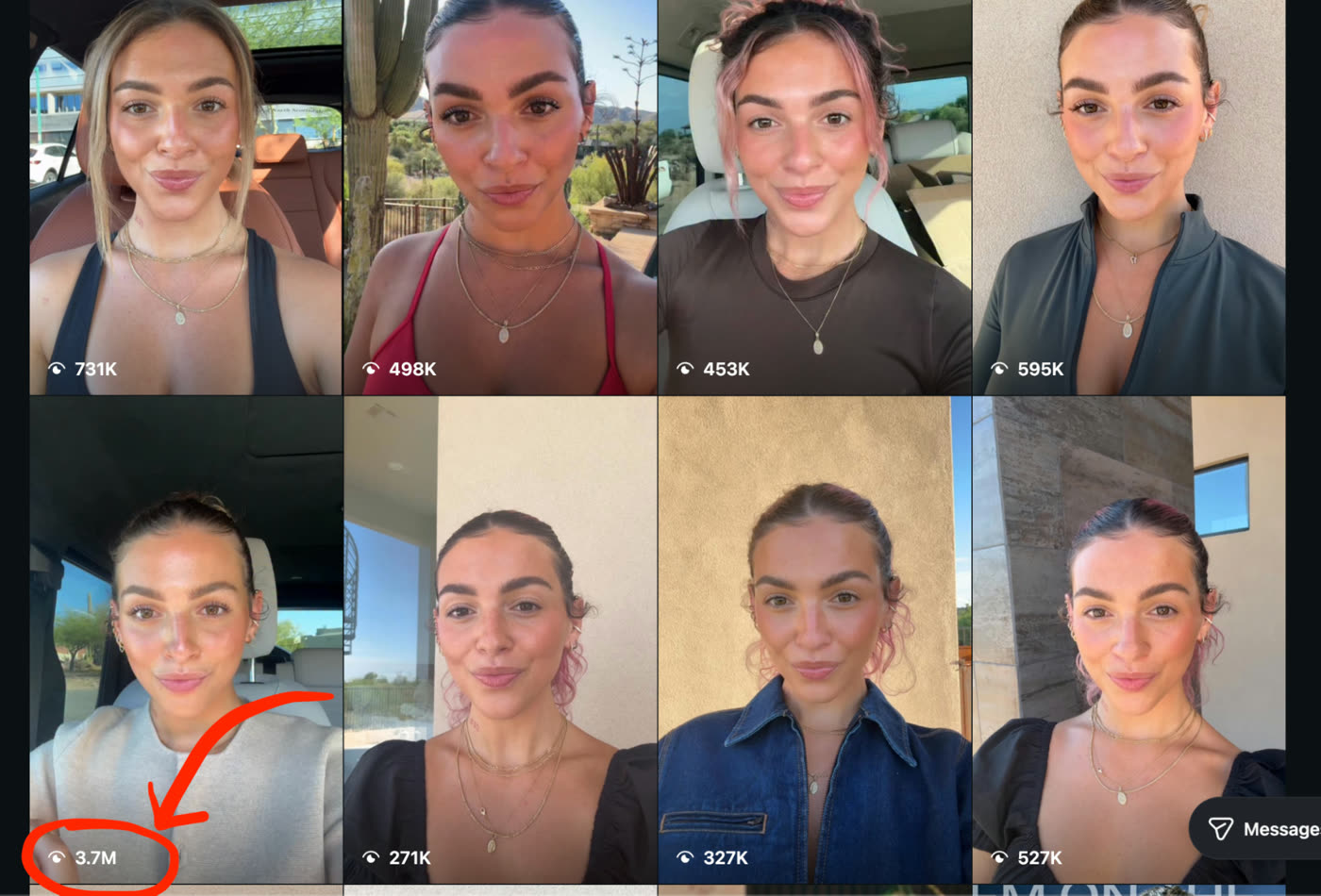
- Once you've identified the outperforming content, copy these elements of the video's structure exactly:
- The visual and verbal hook. For the first ~4 seconds of the video, your content should be indistinguishable from the content of your comp account. If the creator moves their camera slightly as the video starts, you should do this too. If they put a short caption above their head for the first 3 seconds, you should as well. If they cut camera angles at 1.75 seconds into the video, so should you. Attention to detail here is critical, as this section of the content is the single most important contributing factor to virality. The piece of content you're copying has already figured out how to stop the scroll of your potential users; you should incorporate their expertise.
- The format. After the hook, the content of your post will likely diverge since you'll be discussing themes that are specific to your product. Even as your actual content differs from that of your comp account, you should still follow the format of their highly performing video as closely as possible. You should analyze the video to determine how long it is, how many seconds there are between camera cuts, what type of call to action exists at the end of the video, what type of storytelling structure the content follows, along with any other important factors. Once you've analyzed and identified these important components, copy them as closely as possible in your own content.
- The caption structure. Analyze and copy the important elements of the comp post's caption, as captions can be a significant driver of watch time, which is the most important indicator of a video's virality.
- Working within your newly outlined structure, drop in a script that addresses one of your hypothesized customer pain points in a human-first, entertaining, and approachable way. This is where your content will differentiate itself from the comparison account, so make sure to make it your own without deviating from the “ingredients” for virality that you identified in step 3.
- Human-first means you should be making your point by highlighting human examples rather than relying on research or statistics. An effective tactic I used here was to start off with an eye-grabbing statistic (eg. “Scientists say they can predict whether you'll get a divorce”) and then follow it up with a human illustration of the researcher's findings. Using real names makes a share more likely because real people use those names, and it also makes the content relatable, bringing it beyond just a curiosity and into a story that feels relevant to the watcher's life.
- eg. “Alex and Morgan are a couple that's super in love, and they act like x, y, and z. You might think that's normal, but research shows that these habits are likely to lead to divorce. Sam and Avery don't show one another physical affection as often, and their habits look like a, b, and c. Even though their relationship might not seem as passionate, the research actually shows they're much more likely to stay together because of K reason.”
- Entertaining means that the content's copy should continuously open new curiosity loops and end on a punchy, shareable takeaway. There is a lot of good content describing how to write entertaining copy (see the video below), but your content should generally follow this structure:
- Hook that makes the audience curious about some big topic (IE. the problem you'll solve for them)
- Reveal information that will help resolve that curiosity
- “Gotcha” that moves to the next section of the video
- Repeat steps i-iii until the end of the video, where you share a punchy takeaway / solution to the problem.
- Approachable means that the content applies directly to the lives of your users. If a friend shares the content, it should be obvious how the person receiving it could use the advice to improve their life.
- Human-first means you should be making your point by highlighting human examples rather than relying on research or statistics. An effective tactic I used here was to start off with an eye-grabbing statistic (eg. “Scientists say they can predict whether you'll get a divorce”) and then follow it up with a human illustration of the researcher's findings. Using real names makes a share more likely because real people use those names, and it also makes the content relatable, bringing it beyond just a curiosity and into a story that feels relevant to the watcher's life.
Tactic 1.4. Deciding a posting schedule
Put simply, you should post as much as possible while maintaining quality. This will help you learn what content is effective, begin to understand your potential users, and build trust and familiarity more quickly.
In Review: Getting More Views
The big takeaway from this section is that you should plagiarize a lot and use your early posting as an opportunity to build a familiar relationship with your audience.
Problem 2: Getting Viewers to Purchase Your Product
If a user is engaged with your content, but hasn't purchased your offering yet, it could be because of a few different reasons:
- The value proposition of your offering is unclear to them; they don't yet understand how it'll help solve their problems.
- They aren't motivated enough by the pain point to spend money on solving it.
- They don't trust that you understand their problem well enough to solve it.
In this section I'll walk through tactics to address each one of these audience objections.
Tactic 2.1: Clarifying Your Value Proposition
Assuming that your videos have a high rate of virality and your brand is familiar to your audience, your next task is to educate that audience on your specific product. To do this you should create content with that explicit goal. You can expect this “explainer” or mid-funnel content to have far smaller viewership than the content that's designed to get eyeballs, but that's ok because the point of this content is to drive purchases, not to drive awareness.
This mid-funnel content should basically lay out:
- What problem your product is designed to solve
- Why you're the right person to build a product to solve this problem (use expertise or a human story about your particular experience with the problem)
- A before and after user journey describing how your product solves the specific problem
To figure out how to structure this content effectively you should, once again, plagiarize existing effective mid-funnel content in your category and substitute your own solution within that structure. To identify mid-funnel content you should look for explainer-style videos rather than videos that have outperformed on view count.
Tactic 2.2: Amplifying Pain Points
If your viewers aren't purchasing your product, it could be because they don't view your proposed pain point as important enough to spend money solving. To overcome this pitfall you should look to the comment section of your high-performing videos, where you can expect to see users defining their pain points in their own words. One easy way to speak more clearly to the pain your users are experiencing is to quote them verbatim. Don't rephrase the frustrations that they're already communicating to you directly; use the exact language that they do in your mid-funnel content if you want to make sure you're speaking effectively to their pain points.
One other tactic to overcome low motivation is to reduce the friction your user experiences before purchase. You can accomplish this friction reduction by making your calls to action easy to take action on. Use ManyChat automations to deliver your product's app store link directly to your audience's DM inbox rather than making them click into the App Store, for example.
Tactic 2.3: Improving Trust
Even if you communicate a salient pain point very clearly, it's still possible that your audience won't trust you enough to believe that your product will solve that pain.
The primary solution to this problem is generally to get your audience to spend more time with you. The more time an audience spends engaged with your content, the more likely they are to purchase your offering. There are two main ways you can get your audience to spend more time with you:
- Post more so your audience sees a higher volume of your videos at the same length.
- Post longer form content like podcasts or YouTube videos, which are the best performing mediums in terms of conversion specifically because they're much more likely to build a trusting relationship than short-form content. If your audience spends 90 minutes with you, it's highly likely that they'll trust you enough to purchase from you at the end of that experience.
In Review: Getting Your Audience to Purchase
The main takeaway from this section should be that you need to build trust with your audience before expecting them to purchase. To do this, communicate your product's value clearly, directly, in your audience's own words, over an extended period of interaction.
Problem 3: Creating Loyal Customers
Once you've gotten a viewer to purchase your product, it's likely that you'll want to retain them as a user. The main levers you can pull in your marketing to make that happen are:
- To continue posting so your user sees you on their feed and remembers who you are after purchasing their subscription.
- To highlight user success stories in your marketing to continuously demonstrate your product's successes and drive word of mouth.
To tell you the truth, though, retention and growth are primarily a product problem in my experience! I won't go into product growth tactics here, but let me know if you'd like a rundown and I'll do a writeup on those as well.
In Summary: Taking a Product from 0-1 Using Social Media
The most important pieces of going from 0-1 with your product on social media are:
- Choosing a consistent, trustworthy, charismatic face of your brand
- Learning to describe your audience's precise pain points in a clear and entertaining way
- Learning to copy the effective portions of proven content, and including your precise definition of your audience's pain points
- Posting a lot so you can learn a lot.
Leave a comment or shoot me an email at doug.dahl34@gmail.com if this was helpful or if you'd like any more advice! Good luck growing your product 🦾